Objectives for the project
- identify the needs of users
- simplify highly complex search operations
- and to structure the selection process so clearly that users on the JUMO site have their concerns "sorted out".

Better together
Right from the start of the project, JUMO treaded unusual paths. Instead of secretly working out a strategy in the closet and then laboriously coordinating it with the stakeholders, the project management set up an interdisciplinary team of JUMO employees and our UX specialists. This way, the team always had a holistic view of the customer - from a sales and support perspective, but also from the perspective of product development and marketing. At the same time, different disciplines contributed their expertise. With everyone sitting at one table, the development process was accelerated - and results optimised.


What customers think
”For us it was at first unusual to work in such an interdisciplinary way. But our initial reservations soon evaporated when we saw the added value. The joint perspective on the project helped all those involved to gain a better basic understanding of the task at hand.“
Christina Scheer
Head of Media Communication - JUMO GmbH & Co KG

Added empathy though user council
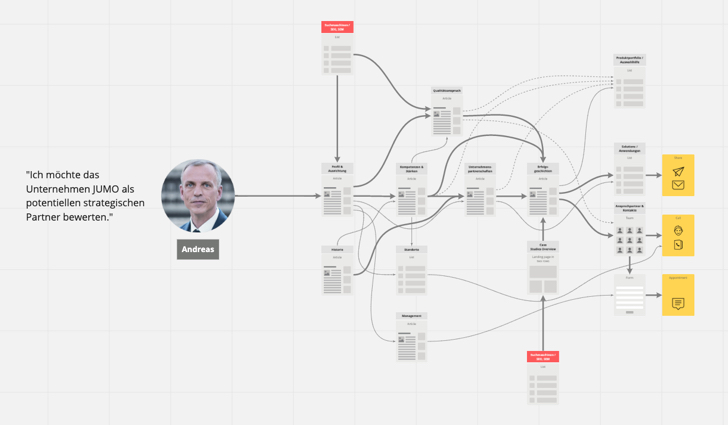
The core UX team gathered and evaluated all information available about the users. Plant designers, maintenance engineers and young technicals (recruitment of new talents) represented the greatest potential. The team concentrated insights about these users from web analytics and personal interviews in personas: a helpful method used by designers to develop empathy for their users and understand their needs.
The Jumo User Council
Here, too, JUMO took the decisive extra step and literally brought the personas to life - with a user council made up of real customers representing the various user types. The user council was involved in the entire process, directing the focus on the customer as early as the development stage and providing valuable feedback in all implementation steps.

Understanding the target group’s core problem
During the research phase, the users’s pain points soon surfaced. Plant designers and maintenance engineers find themselves under great time pressure, because plants standing still or not functioning efficiently cost money. They need to be up-to-date at all times to be able to implement innovative and appropriate applications. Maintenance engineers are responsible for ensuring smooth operation. In order to quickly obtain a spare part, they will sometimes travel all across Germany.
An opportunity for JUMO
A partner who offers state of the art solutions and provides spare parts im simple ordering processes is valuable support for users. However, on the exisiting JUMO site, the necessary information was sometimes hard to find within the flood of information – or not at all. When a customer needed a product or wanted to download a specific document, they would instead pick up the phone and have support guide them through the online process. Expensive for JUMO, awkward for the customer. And most certainly not an option for new customers.

When a customer needed a product or wanted to download a specific document, they would instead pick up the phone and have support guide them through the online process.
Expensive for JUMO, awkward for the customer.
And most certainly not an option for new customers.
Setting a clear focus
Therefore, all user relevant areas were given initial priority: applications, products and service. All other content was was placed at the bottom of the list.
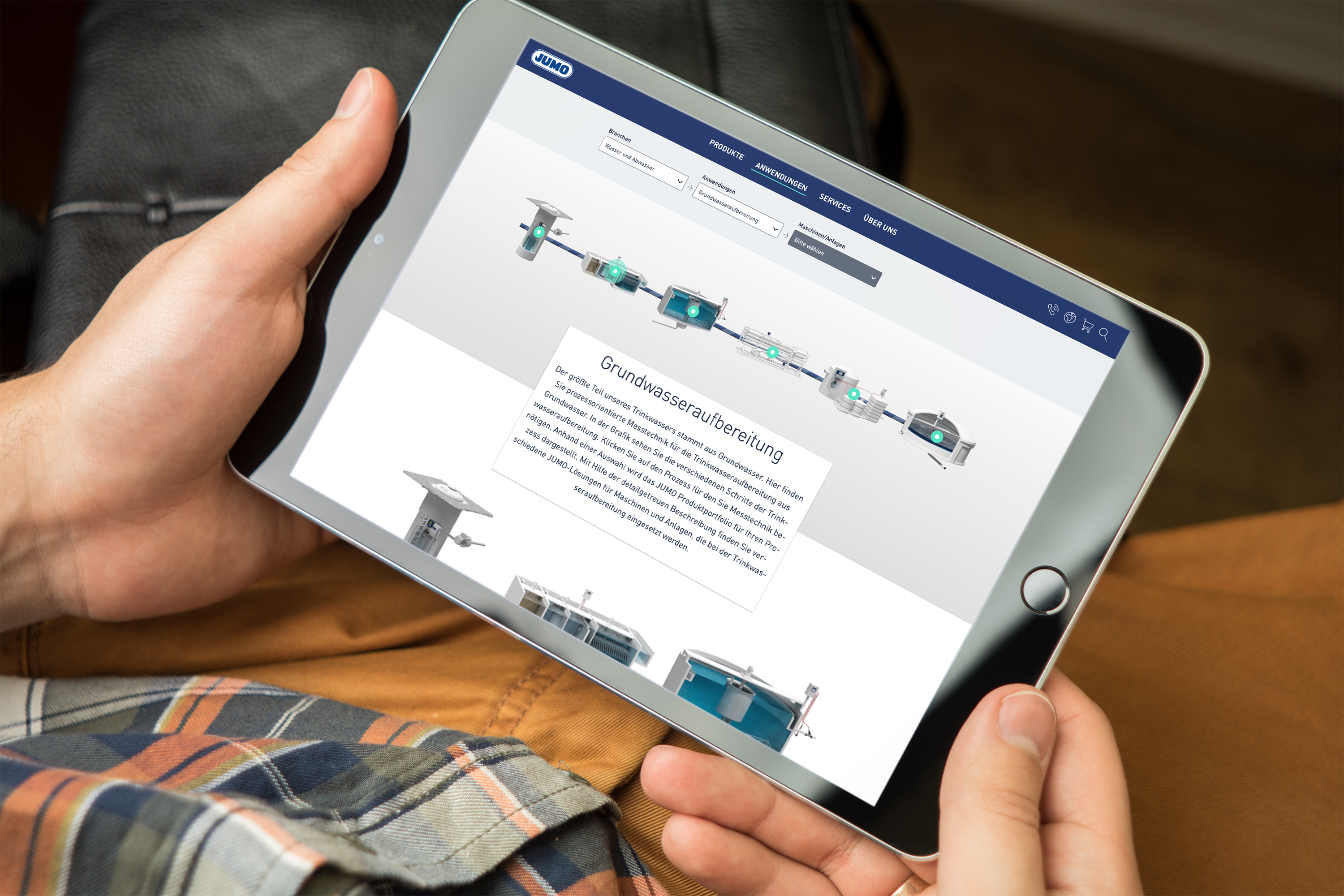
In „Applications“, plant designers find system solutions with innovative sensor, control and automation technology.
In the product area, maintenance engineers can access an online catalogue for configurable standard products. To this end, a product configurator which was previously only accessible to the sales department was installed online.
In the service area, all target groups find background information about products and support, such as handbooks and data sheets in the download center.


What customers think
”At JUMO we have been dealing with the buzzword "Customer Centricity" for quite some time. But what it means in practical terms, and how today, one can actually put the customer's needs in the focus of one's activities, we only became aware of much later in the course of the project.“
Michael Diegelmann
Leiter Marketing - JUMO GmbH & Co KG
Validation in the user council
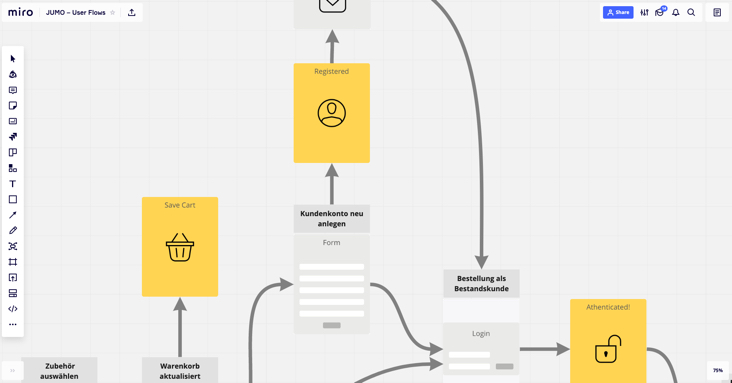
The page structure was built as a prototype to check whether it would be comprehensible to the user council. A test is run as follows: A user tests different features of the prototype and articulates his or her thoughts on the phone with an expert who may support by asking specific questions. Mouse activity is recorded and provides valuable insights into the user's experience.
Valuable insights
- Users searched for specific articles rather than comparing products - a crucial insight for development, since a module for the comparison of products would have required significant additional technological effort.
- Product costs played a smaller role than quality and reliable delivery.

If you fail, fail fast!
The page structure was built as a prototype to check whether it would be comprehensible to the user council. A test is run as follows: A user tests different features of the prototype and articulates his or her thoughts on the phone with an expert who may support by asking specific questions. Mouse activity is recorded and provides valuable insights into the user's experience.
Key Feature
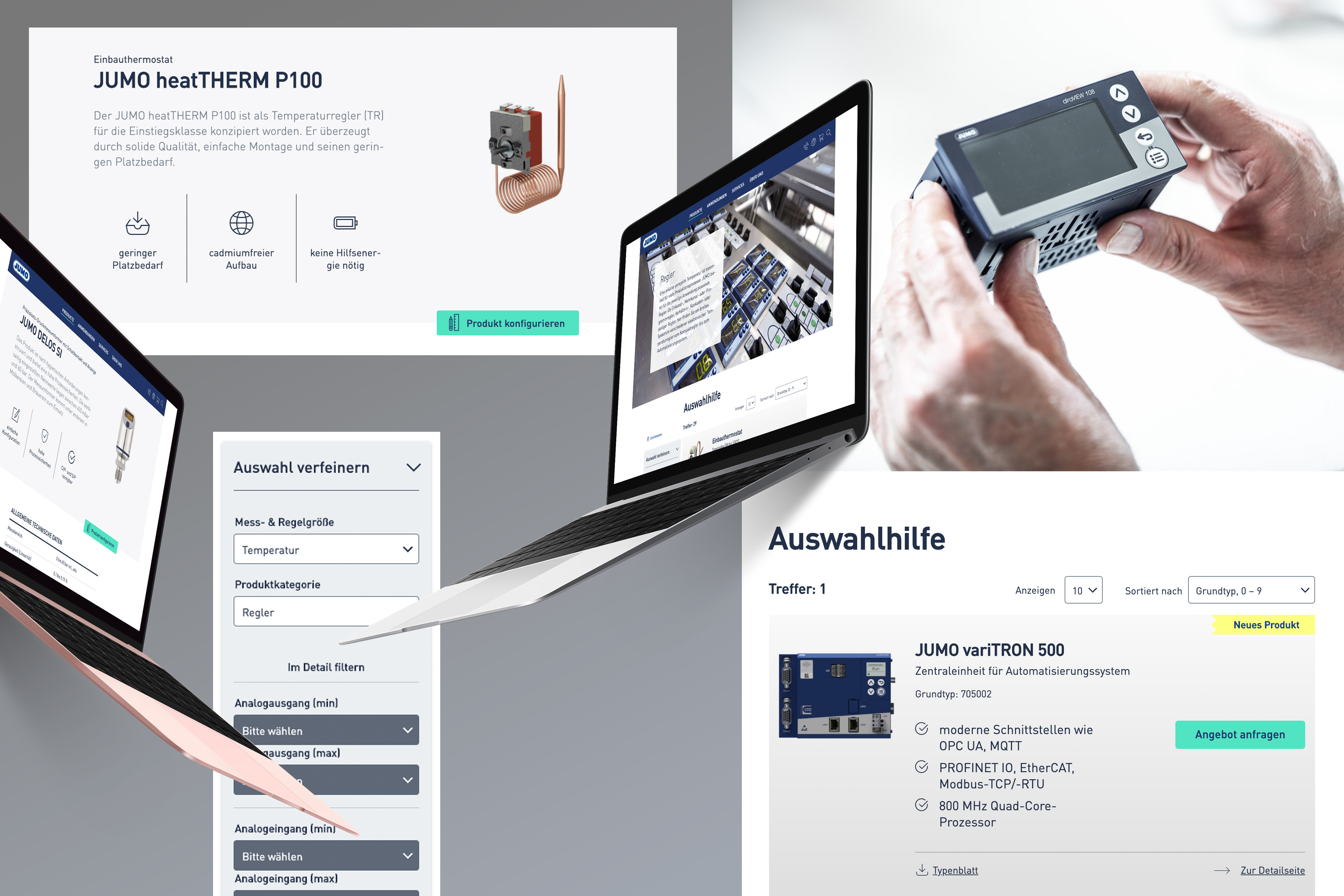
JUMO offers a large number of standard components that can be configured for the required application. For the convenient search of their large product catalog, a selection guide was specifically developed.

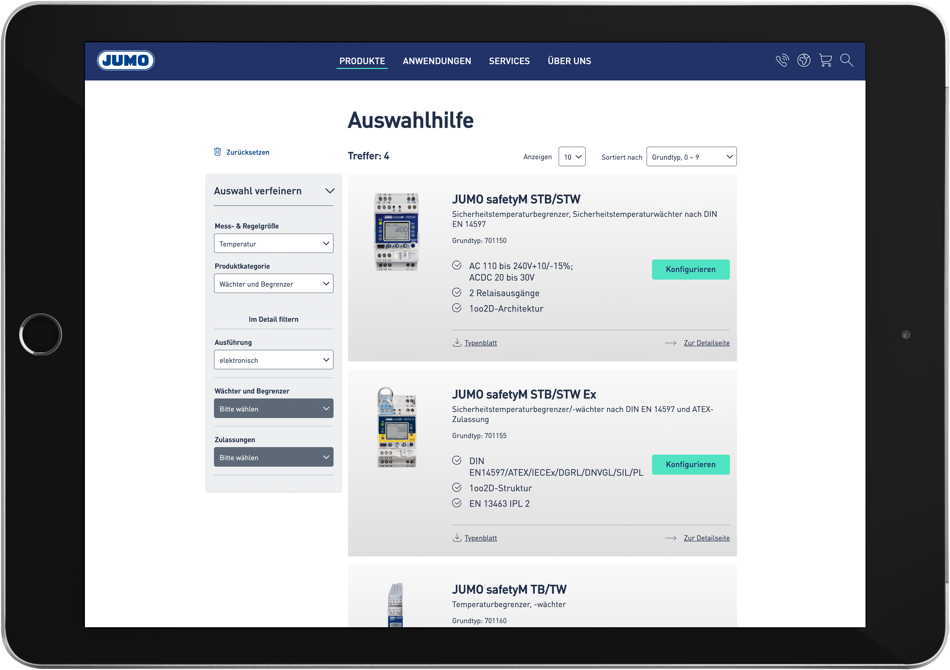
The biggest challenge for the team was choosing the filter criteria important to the user, and their arrangement. Here, once again, the value of teamwork became evident: sales and product development were familiar with the most important units and terms from their daily interaction with customers, and were able to provide valuable input when creating the filter groups. These were then reviewed and refined again with the user council. Customers can now find the right product quickly and easily by filtering in the selection guide.
About searching and finding solutions
The result: a website geared towards the user, where JUMO customers can easily find the product they are looking for - a consistently positive user experience. For JUMO, this means:
- Saving of support time, as customers can manage tasks themselves.
- More turnover through online orders from new customers and retention of existing customers.
- Positioning as a partner who supports customers in creating suitable solutions.
- A positive overall impression, because JUMO offers customer-friendly service. The contact is pleasant throughout.
A great start
The creation of the website is only the beginning. JUMO is planning to expand shop functionalities such as improving the payment process or saving data for recurring orders. In addition, JUMO wants to integrate online sales with production in order to automatically re-order and deliver components.

Our conclusion: As a forward-looking partner, JUMO is steering its customers towards Industry 4.0.